
How a leading Australia-based cardiac diagnostics organization partnered with Techindia to simplify MCT workflows, accelerate ECG review, and scale operations without increasing clinical resources.
As Mobile Cardiac Telemetry (MCT) volumes increased, a leading Australia-based cardiac diagnostics organization faced a growing operational challenge. Clinicians were spending significant time reviewing ECG recordings, preparing reports, and managing manual workflows, affecting both turnaround times and operational efficiency.
The organization partnered with Techindia to implement the AP MCT platform. What began as a 10-week pilot progressed into everyday cardiac monitoring operations, helping the organization simplify its MCT workflow, accelerate ECG review, and support increasing study volumes without proportionally increasing clinical resources.
As the organization's patient base grew, its existing MCT workflow became increasingly difficult to scale. More studies required more clinical time for ECG review, reporting, and administrative work.
The organization needed to:
The challenge was not limited to ECG analysis. The complete workflow, from rhythm review to reporting and EMR integration, needed to become more efficient.
Techindia implemented AP MCT through a phased approach, allowing the organization to validate the platform within its existing clinical environment before moving to regular operations.
The pilot was conducted across selected clinicians and patient studies to validate performance, optimize workflows, and establish EMR integration.
During this phase, Techindia implemented:
The pilot demonstrated measurable improvements and provided the foundation for wider adoption.
Within three months, AP MCT transitioned into Business as Usual (BAU) and became part of the organization's day-to-day cardiac monitoring operations.
The platform supported clinicians across multiple locations with AI-assisted rhythm analysis, structured reporting, digital workflows, and integrated patient information.
Following the transition to BAU, the organization recorded improvements across ECG review, reporting, administration, and overall operational efficiency.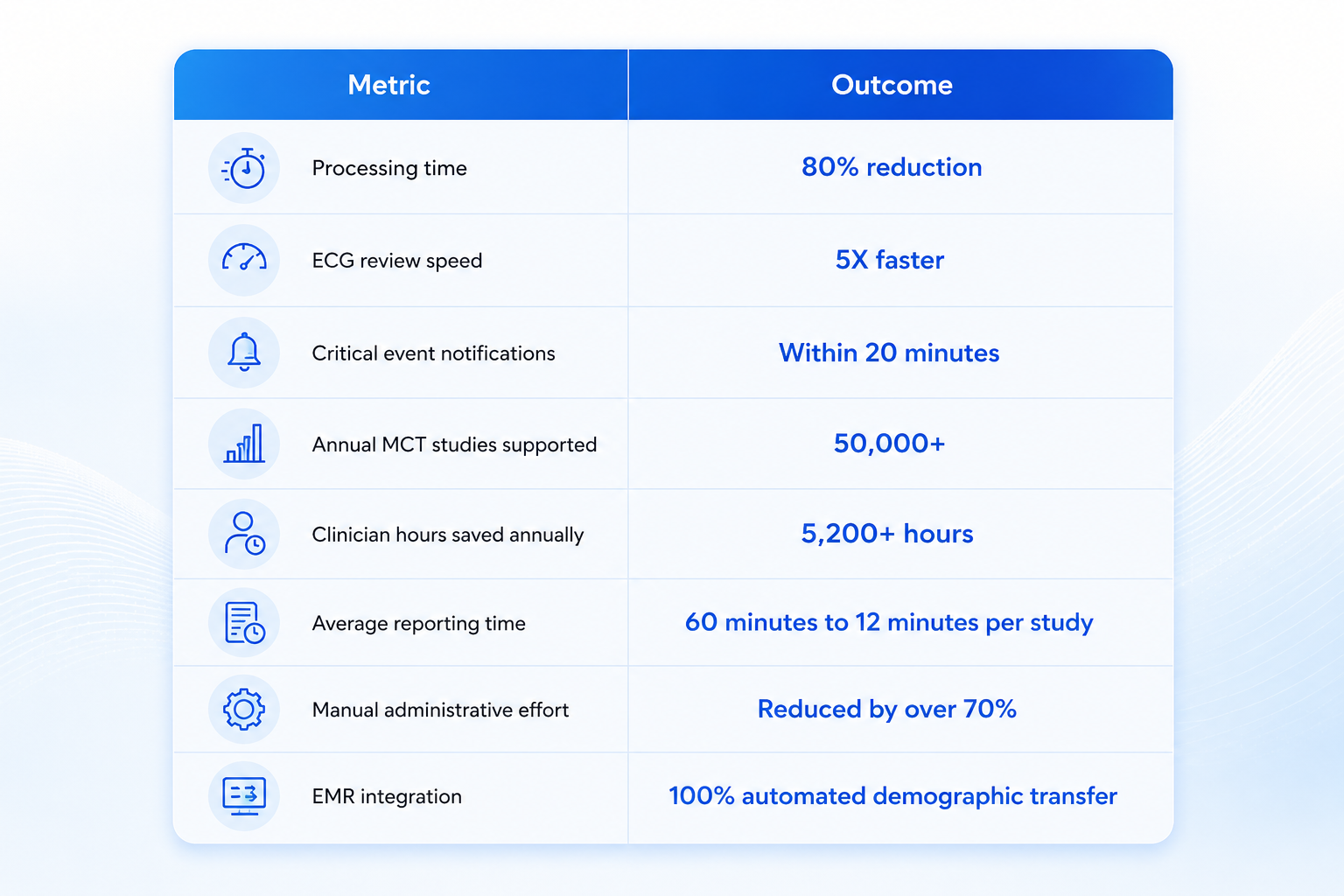
The results show the impact across the complete MCT workflow. Faster ECG review shortened reporting time, while automated demographic transfer and digital workflows reduced repetitive administrative work.
Together, these improvements enabled the organization to support more than 50,000 cardiac monitoring studies annually without proportionally increasing staffing, while saving more than 5,200 clinician hours each year.
The implementation also improved how clinicians and patients interacted with the monitoring process.
The AP Patient App with digital event diary supported mobile monitoring and symptom tracking. For clinicians, the cloud-based portal, queue segregation, customizable reports, and EMR integration brought ECG review, reporting, and patient information into a more structured workflow.
Critical event notifications were delivered within 20 minutes, helping clinically significant events move through the monitoring process efficiently.
What began as a 10-week pilot evolved into a long-term strategic partnership. Today, AP MCT is embedded within the organization's everyday cardiac monitoring operations and supports clinicians across multiple locations.
The implementation helped the Australian cardiac diagnostics provider move from a time-intensive, largely manual process to a more structured and scalable MCT workflow.
For this Australian cardiac diagnostics provider, increasing MCT volumes required more than faster ECG analysis. The organization needed to improve how ECG data moved through review, reporting, administration, and its existing EMR.
Through the phased implementation of AP MCT, Techindia helped create a more efficient workflow that could support increasing cardiac monitoring volumes without proportionally increasing clinical resources.
The result is an MCT operation built to support greater scale while reducing the time and manual effort required to process each study.








 Previous

