
Explore how remote ICU monitoring works, how eICU platforms support bedside teams in real time, and why hospitals without round-the-clock specialist coverage rely on Tele-ICU solutions.
Critical care units worldwide are facing growing pressure from rising patient acuity, increasing ICU demand, and a persistent shortage of experienced intensivists and critical-care staff. Maintaining consistent, high-quality ICU coverage, especially outside standard working hours, has become a significant operational challenge for many hospitals.
Remote ICU monitoring, also known as eICU, Tele-ICU, or virtual ICU, addresses this challenge by extending critical care expertise beyond physical ICU walls. Through centralized monitoring platforms, remote clinical teams provide continuous oversight, early risk detection, and decision support for bedside ICU teams.
This article explains what remote ICU monitoring is, how it operates, where it is used, who provides eICU solutions, and why it is particularly valuable for hospitals without round-the-clock specialist coverage.
A remote ICU (eICU) is a technology-enabled critical care model in which ICU patients are continuously monitored through centralized Tele-ICU platforms by off-site intensivists and trained clinical monitoring teams.
Using real-time physiological data, clinical systems, audio-visual connectivity, and advanced analytics, remote ICU teams support bedside clinicians by providing continuous surveillance, escalation guidance, and clinical decision support.
Importantly, remote ICU programs are designed to augment, not replace, bedside care. Clinical decisions remain with on-site teams, while remote specialists act as an additional layer of oversight and expertise.
A typical remote ICU model includes:
This operating model enables hospitals to deliver consistent, high-quality critical care even when on-site specialist availability is limited.
Remote ICU platforms integrate multiple clinical data streams to create a comprehensive, near real-time view of each patient’s condition.
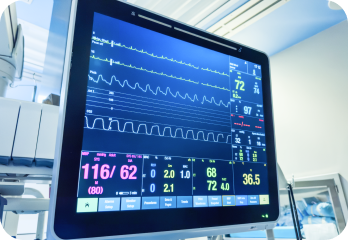
Continuous tracking of heart rate, blood pressure, oxygen saturation, respiratory rate, and invasive hemodynamic parameters enables early recognition of physiological deterioration.
Real-time feeds from ventilators, infusion pumps, dialysis machines, and other ICU equipment provide visibility into therapies and device performance.
Remote ICU teams access EMR/EHR data, laboratory results, imaging reports, and medication orders to support informed clinical assessments.
Two-way video and audio links allow direct communication between remote intensivists and bedside clinicians.
Rule-based and AI-assisted analytics flag early signs of deterioration, sepsis risk, and ventilator-associated complications.
Together, these capabilities enable continuous surveillance, early identification, and more standardized ICU care across multiple locations.
Remote ICU monitoring is applied in several critical care scenarios, particularly where staffing constraints or expertise gaps exist.
Remote ICU models are also used proactively, not only to respond to emergencies, but to prevent complications through early detection and protocol-driven interventions.
The eICU ecosystem includes a combination of technology providers, clinical service organizations, and integrated care models.
Hospitals typically select eICU partners based on scalability, interoperability, clinical expertise, regulatory compliance, and alignment with existing workflows, not technology alone.
For hospitals lacking full-time intensivist coverage, remote ICU monitoring delivers meaningful clinical, operational, and strategic benefits.
For diagnostic and clinical support organizations such as Techindia, remote ICU monitoring aligns with broader telehealth and critical-care support models that combine real-time monitoring, centralized expertise, and scalable operations.







 Previous
