
Explore how remote ECG monitoring works in real-world clinical environments, from device setup and data transmission to expert interpretation and global workflow execution.
Remote ECG monitoring has become an essential component of modern cardiac diagnostics as healthcare systems shift toward continuous, technology-enabled care. While capturing ECG signals is fundamental, successful remote ECG monitoring depends on reliable devices, secure data transmission, expert interpretation, and clearly defined clinical workflows.
This guide outlines how remote ECG monitoring is implemented in real-world clinical environments, with a focus on what hospitals, IDTFs, cardiologists, and general practitioners need to understand. It also highlights how globally aligned Indian diagnostic providers support large-scale ECG monitoring services worldwide.
Remote ECG monitoring is a diagnostic method where a patient’s cardiac electrical activity is recorded outside a hospital or clinic and securely transmitted to clinicians for review and interpretation. Unlike a standard in-clinic ECG, which provides only a single snapshot of cardiac activity, remote ECG monitoring enables extended rhythm assessment over several days or even weeks.
Clinicians use remote ECG diagnostics to:
For healthcare organizations, remote ECG monitoring expands diagnostic reach, enhances patient convenience, and enables scalable cardiac care without the need to grow physical infrastructure.
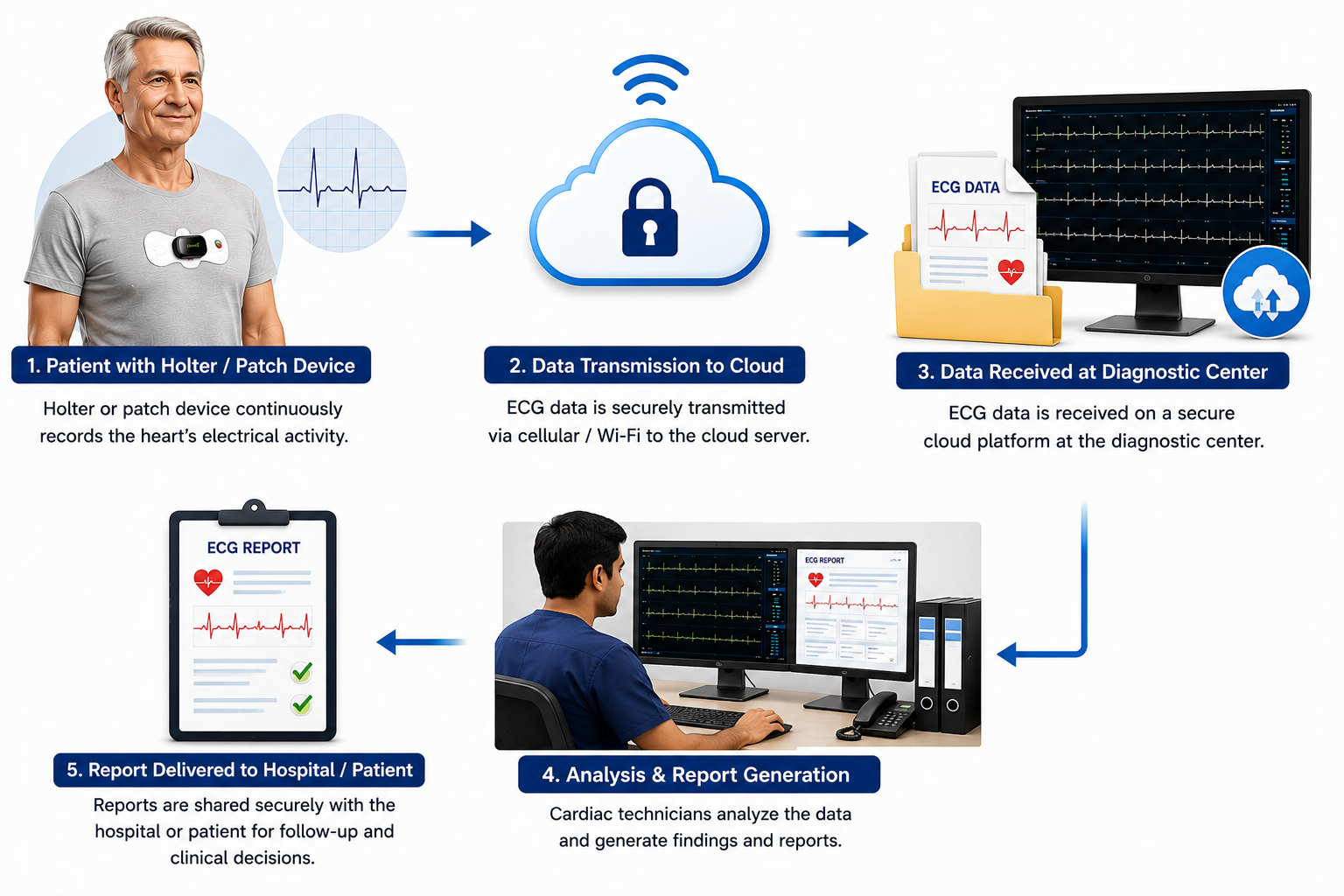
Remote ECG monitoring begins with medical-grade ECG devices designed for ambulatory use. Depending on clinical requirements, these may include patch-based monitors, wearable ECG recorders, or compact telemetry devices.
The recording and transmission process generally follows these steps:
Signal Capture
ECG electrodes placed on the patient’s chest detect the heart’s electrical activity and convert it into digital waveforms.
Local Processing and Storage
The device filters noise, timestamps events, and temporarily stores ECG data to preserve signal quality.
Secure Data Transmission
The wearable or patch device transmits ECG data to a paired mobile device via Bluetooth. From there, the data is securely sent through cellular or Wi-Fi networks to a cloud-based monitoring platform.
Remote Access for Review
Authorized cardiac technicians and clinicians access ECG data through secure dashboards for near real-time monitoring or scheduled interpretation.
This architecture ensures reliable data flow while maintaining patient safety and data privacy.
Choosing the appropriate monitoring duration is critical for achieving accurate diagnostic outcomes.
24–48 Hour ECG Monitoring
Best suited for frequent symptoms or known arrhythmias. This approach is often used as an extension of traditional Holter monitoring.
7-Day ECG Monitoring
Improves detection of intermittent rhythm abnormalities that may not occur within the first 48 hours.
30-Day Remote ECG Monitoring
Designed for rare or unpredictable events such as paroxysmal atrial fibrillation or unexplained syncope. Event-triggered and continuous recording options significantly increase diagnostic yield.
While longer monitoring durations provide more comprehensive data, they require structured workflows and expert interpretation to ensure the findings remain clinically meaningful.
One of the biggest challenges in remote ECG monitoring today is not device availability, but effective workflow execution. The success of remote ECG diagnostics depends on how efficiently the entire process is managed.
A typical remote ECG workflow includes:
Many hospitals and IDTFs collaborate with specialized ECG diagnostic service providers such as Techindia to manage monitoring, interpretation, and reporting. This approach allows clinicians to focus on patient care while minimizing operational complexity.
Globally, remote ECG monitoring follows standardized clinical and technical frameworks, regardless of geography. The key difference lies in how diagnostic services are delivered at scale.
Healthcare systems increasingly rely on distributed diagnostic models, where ECG data is captured locally and interpreted remotely by qualified cardiac professionals. Indian diagnostic providers play a significant role in this ecosystem by offering:
For global hospitals and diagnostic networks, partnering with Indian providers enables scalable ECG rhythm interpretation services without compromising accuracy, compliance, or clinical quality.
At Techindia, remote ECG monitoring services are designed to integrate seamlessly into global clinical workflows, supporting hospitals, IDTFs, and cardiology practices worldwide.








 Previous
